
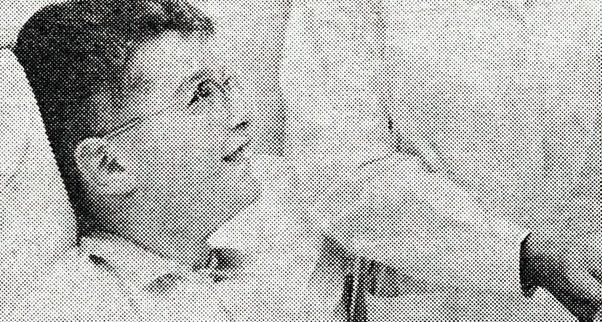
John Ault
21st April 2026
It was Easter of 1957 when I contracted polio at the age of five, following a day trip to Margate beach. The illness led to partial paralysis of my legs and a curvature of the spine. I remember playing with a dead starfish at the time. The shoreline wasn’t as clean as it is today, so I can only assume that’s how I caught the virus.
I remember feeling like I had the flu, and my parents were extremely worried. Then men in masks arrived to take me to the hospital in an ambulance. I was frightened, but everything after that is a blur. I was told that I was temporarily placed in an iron lung in the isolation ward at Joyce Green Hospital near Dartford, Kent, and then confined to a room for months with a glass partition separating me from my parents.
I vividly recall the brief visits from loved ones. It was so hot in my room that my mum and her friend once had to hang their coats up at the window to help lower my temperature.
Health care was a postcode lottery back then, so I was basically left to languish in bed, which caused the muscles in my left leg to waste away and worsened the curvature of my spine. In contrast, patients at other hospitals received intensive physiotherapy early on, which greatly improved their outcomes. By the time I finally received physiotherapy, it was too little, too late. However, my spine curvature did improve somewhat after long swimming lessons at Madame Osterberg’s College in Dartford.
What followed were 10 years of operations at Joyce Green and West Hill Hospital, most of which were unsuccessful, particularly the attempt to fuse my ankles. My specialist surgeon was a terrible man—feared by both staff and patients. He would become very angry if anyone dared to politely question why he was performing a particular procedure. He often reduced my mother to tears.
I sometimes spent months in the hospital, where the staff, for the most part, were firm but kind. I particularly remember a huge Irish matron and a staff nurse who were both lovely. The worst part was the short visiting times—just half an hour. I dreaded the sound of the “time up” bell, and even today, I still shiver when I hear a similar sound. My poor mum and dad, who worked shifts on the railway, didn’t have a car, so getting to the hospital involved traveling by two buses and a train. On a few occasions, they couldn’t make it on time, but no allowances were made, and sometimes I only had five minutes with them.
Wards back then were almost militaristic in how they were run, and for a child, being separated from loved ones was incredibly upsetting. I’m 72 years old now, and it still haunts me. However, there were some happy moments, mainly from interacting with other children. Some were worse off than me but displayed extraordinary courage and bravery, especially the burn victims.
Sadly, not everyone in the hospital made it. I was fortunate to have a life they never had the chance to experience. As time goes on, their faces sometimes return to visit me in the early hours, a haunting reminder that comes with age. But life is good, and I’m always thankful for being blessed with a wonderful wife, two lovely children, grandchildren who bring me joy, and many good friends.
I worked for 37 years as a Senior Engineering Technician at a local college, which, coincidentally, was partially housed in the old Madame Osterberg’s building where I once swam.